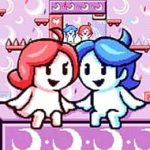
Heart Star looks like a sweet, pastel-colored platformer about two characters falling for each other, but it plays like a logic puzzle that punishes anyone who treats it as a straightforward jump-and-run.
Star Boy and Heart Girl Exist in Separate Worlds
The entire game hinges on one rule: Star Boy can only stand on blue star platforms, and Heart Girl can only stand on red heart platforms. Purple blocks are the one shared surface both characters can use, which becomes the connective tissue of nearly every level once you start noticing it.
This isn’t a cosmetic skin over a normal platformer — it’s the actual puzzle engine. Every stage in Heart Star is really two overlapping layouts that only make sense once you’ve walked both of them separately and started thinking about how they intersect.
Early in the game the levels are gentle enough that you can muddle through without fully internalizing the rule. That stops working within the first handful of stages, once color-locked platforms start appearing in combinations that require real planning rather than trial and error.
Swapping Between Star Boy and Heart Girl
You swap control between the two characters with a single button, and that swap is the verb the entire game is built around. One character often has to act as a stepping stone, a bridge, or a counterweight so the other can reach somewhere otherwise impossible.
Speedrunners in the community talk about “swap timing” the way platformer fans talk about frame-perfect jumps — it’s the skill that separates a level completed in ten seconds from one that takes two minutes of trial and error.
What Beginners Consistently Get Wrong
New players almost always try to solve each side of a level independently, the way you’d solve two separate stages back to back. Heart Star doesn’t work that way. Because the worlds are linked, an action you take as Star Boy can directly affect what Heart Girl is able to do a moment later, even if you’ve already swapped away from her.
The other early mistake is forgetting that danger doesn’t pause just because you’ve swapped views. If you leave Heart Girl standing next to spikes in her world and switch over to play as Star Boy, she isn’t safe just because she’s off-screen — the game keeps both characters live at all times.
Piggybacking and Platform Manipulation
By the time you reach the levels built around moving blocks, the mechanics expand past simple platform-matching. You’ll need one character to carry, push, or catch the other, using their body as a temporary platform to close a gap that neither could clear alone.
Switches and doors get layered on top of the color-locked platforms once teleporters start appearing, and that’s usually the point where a level stops being solvable by intuition and starts requiring you to map out both worlds mentally before moving either character.
Reaching the Golden Portal
Every stage ends the same way: both characters need to reach the glowing goal together, not separately. A level isn’t finished the moment Star Boy arrives — Heart Girl has to get there too, which means the last few seconds of a stage are often the trickiest, since you’re managing two positions on the board at once with no room left for error.
What surprised me the first time a level clicked was realizing the solution had been sitting there since the opening screen — I just hadn’t swapped characters at the right moment to see it. That’s the specific feeling Heart Star keeps chasing across its full run of levels, and it lands more often than not.
Ice Physics and Timed Obstacles Later On
Later stages introduce ice-based platforms that carry momentum differently than the standard blocks, along with timed obstacles that punish hesitation. These additions don’t replace the core swap mechanic, they just stack new constraints on top of it, which is why difficulty in Heart Star ramps up gradually rather than spiking suddenly.
Why the Length Divides Players
The most commonly debated aspect of Heart Star in player communities is how short the full run feels once you’ve learned the swap timing. Some players see the tight level count as a strength — nothing overstays its welcome, and every stage introduces or remixes an idea rather than padding for length. Others wish the color-locked mechanic had another act’s worth of levels to explore, since the systems clearly have more puzzle potential than the game uses.
Either way, there’s little filler between the opening tutorial stages and the final levels, which is part of why speedrunning the full set has become a small but consistent corner of the community.
Heart Star spends its entire runtime insisting that Star Boy and Heart Girl need each other to get anywhere, and by the time you’re piggybacking one across a gap to save the other from a wall of spikes, that framing stops being a cute premise and starts feeling like the actual point of the design.








 Play Game


 Fullscreen